AI search is rewriting SEO: what AEO and GEO mean for your brand in 2026
For twenty years, getting found online meant one thing: rank on Google, earn the click, win the visit. That deal is breaking. People still search constantly, but a growing share of them never leave the results page. They read the AI answer, get what they came for, and move on.
If your marketing still treats a blue link in position one as the prize, you are optimising for a game that is quietly being replaced. The new game has a name, two of them in fact: answer engine optimisation (AEO) and generative engine optimisation (GEO). Here is what is actually happening, the figures behind it, and the moves worth making this quarter.
The click is disappearing, and the data is blunt about it
Start with the behaviour. Roughly 58% of Google searches in the US now end without a single click to any website, according to Semrush's 2025 zero-click analysis. People get their answer inside the search page and stop.
A big driver is Google's AI Overviews, the AI-written summary that sits above the normal results. At the start of 2025 it appeared on under 5% of searches. By late 2025 it was showing on roughly a quarter of all queries. That is a feature going from fringe to default in about twelve months.
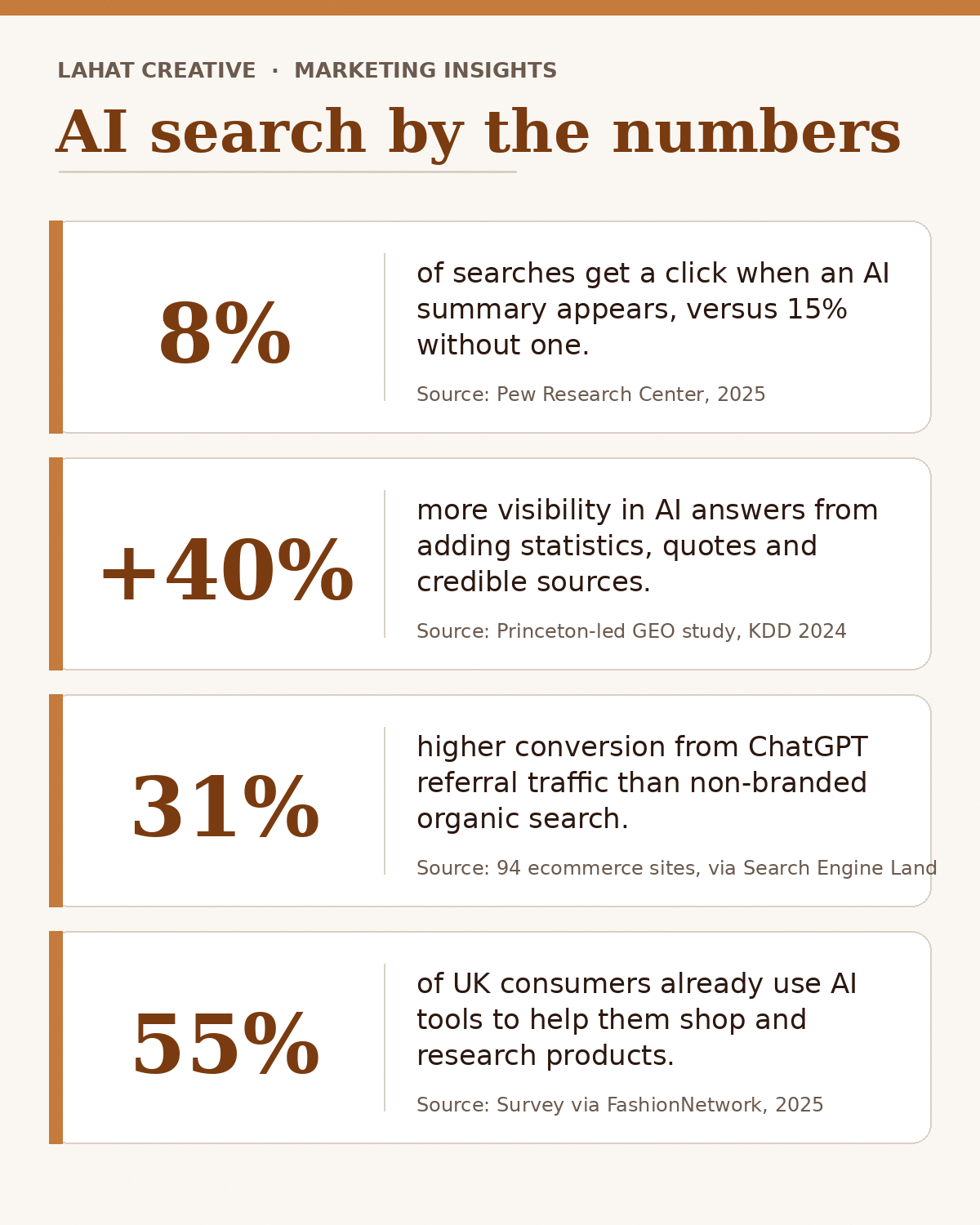
The effect on clicks is real, and a primary source nails it. The Pew Research Center tracked the actual browsing of 900 US adults. When an AI summary appeared, people clicked a normal search result just 8% of the time. When no summary appeared, they clicked almost twice as often, 15% of the time. And the link inside the AI summary itself? People clicked it on just 1% of visits. Ahrefs, looking at top-ranking pages, found AI Overviews linked to roughly a 58% drop in click-through rate for the number-one organic result.
Read that back. The summary answers the question, very few people click anything, and the brands that used to earn that traffic get less of it. This is the part that should focus the mind: the traffic is not moving to a competitor. For many queries it is simply not happening.
Meanwhile, a second search engine appeared overnight
While Google reshapes its own results, an entirely new front opened. ChatGPT reached around 800 million weekly users by late 2025, OpenAI's Sam Altman confirmed, and crossed 900 million in early 2026. It handles roughly 2.5 billion prompts a day. A large share of those are not coding questions or essay help. They are searches: which supplier, which product, who is good at this, what should I buy.
People now research brands inside AI tools before they ever touch a search bar. A 2025 survey reported by FashionNetwork found 55% of UK consumers already use AI tools to help them shop, for product research, recommendations and finding deals. Adobe Analytics, tracking over a trillion visits, reported AI-referred traffic to US retail sites growing several hundred percent year on year.
So there are now two questions every brand has to answer, not one. How do I show up in Google's AI answers, and how do I show up when someone asks ChatGPT, Gemini, Claude or Perplexity directly?
AEO and GEO, in plain English
These two acronyms get used interchangeably. They are related but not the same.
Answer engine optimisation (AEO) is about being the answer. It covers AI-powered search features like Google's AI Overviews and featured snippets, plus voice assistants. The aim is to structure your content so a machine can lift a clean, correct answer straight from your page and credit you for it.
Generative engine optimisation (GEO) is about being cited by the large language models themselves: ChatGPT, Gemini, Claude, Perplexity. When someone asks one of these tools a question in your field, GEO is the work that makes your brand the source it names and links.
Both sit on top of classic SEO rather than replacing it. The technical foundations still matter: a fast, crawlable site, clear structure, schema markup, genuine authority. AI engines largely pull from the same web they always did. What changes is what wins. Old SEO rewarded the page that ranked. AEO and GEO reward the page that gives the clearest, best-evidenced, most quotable answer.
The counter-intuitive bit: AI traffic is worth more, not less
It would be easy to read all this as pure loss. Fewer clicks, harder to measure, what is the point. The numbers push back on that.
The people who do click through from an AI answer tend to be further along and more serious. A study of 94 ecommerce sites, reported by Search Engine Land, found ChatGPT referral traffic converted around 31% higher than non-branded organic search. Semrush's analysis suggests an AI search visitor can be several times more valuable than a typical organic one, because the AI has already done the filtering and sent a warmer, better-qualified person your way.
Think about how you use these tools yourself. You ask a real question, you get a shortlist, you click the one that fits. That click is not a casual browse. It is closer to a recommendation from someone who just researched the whole market for you. Fewer visits, but better ones. The brands that win the citation win the buyer, not just the pageview.
How AI engines decide who to cite
This is where guesswork ends and evidence starts. A research team led by Princeton University ran the first proper study of what actually lifts a brand's visibility inside AI-generated answers. They tested thousands of queries and published the work at the KDD 2024 conference.
The finding is refreshingly practical. The methods that moved the needle most were not tricks. They were: adding relevant statistics, including credible quotations, and citing reliable sources. Pages that did this well saw visibility in AI answers rise by up to 40%. In other words, the content that reads like a well-sourced, authoritative answer is the content the machines quote.
That matches what you see in the wild. AI tools are trying to give a trustworthy answer. They reach for content that sounds like it knows what it is talking about: specific numbers, named sources, direct quotes, clear structure. Vague, padded, opinion-only writing gets passed over.
There is a neat irony here. The same qualities that make content useful to a human reader, evidence, clarity, honesty, are exactly what makes it quotable to a machine. Good marketing and good AEO are pulling in the same direction.
What this means for a UK brand right now
If you run or market a business in the UK, a few things follow directly.
Your customers are already doing this. With 55% of UK shoppers using AI tools to research purchases, the question is not whether AI search affects you. It is whether you show up when it happens. Right now, for most small and mid-sized brands, the honest answer is no, because nobody has done the work yet. That is the opportunity. AI search is still early enough that being visible is a genuine edge rather than table stakes.
Measurement gets harder before it gets easier. A customer who found you through ChatGPT, then typed your name into Google, looks like "direct" or "branded search" traffic in your analytics. The AI influence is invisible in most dashboards. If you judge channels purely on last-click attribution, you will undervalue exactly the thing that is growing fastest.
Brand mentions matter more than ever. AI tools build their picture of you from across the web: press coverage, reviews, directories, mentions on sites you do not own. A brand that is talked about in credible places gets cited. A brand that only exists on its own website does not give the machines enough to go on. This is where PR, content and digital actually converge.
A practical playbook: where to start
You do not need to rip up your marketing and start again. You need to add a layer. Seven moves, in rough priority order:
- Answer real questions directly. For every important topic, write the clear, specific answer a customer would ask, and put it near the top of the page. Lead with the answer, then explain. Machines and busy humans both reward it.
- Put evidence in your content. Specific figures, named sources, real quotes. This is the single best-supported lever from the Princeton work. "We are a leading agency" is worthless to an AI. "We grew British Motor Show ticket sales by 21%" is quotable.
- Add structured data. Schema markup for FAQs, products, reviews, organisation details and articles helps engines read and trust your pages. It is unglamorous and it works.
- Build mentions off your own site. Press, podcasts, guest articles, quality directories, reviews. The more credible places that talk about you, the more raw material AI tools have to cite you from.
- Get your basics fast and clean. Speed, mobile, clear headings, crawlable structure. AI engines pull from the same web; a site they cannot read easily is a site they will not quote.
- Track AI visibility deliberately. Ask ChatGPT, Gemini and Perplexity the questions your customers would ask, and see whether you appear. Do it monthly. It is the new rank check.
- Keep earning the human, not just the bot. The point of being cited is the qualified visitor who follows the citation. Make sure that when they arrive, the page actually sells.
The short version
Search did not die. It split. People still look for what you do every day, but increasingly they ask a machine, read an answer, and click only when something earns it. Google's AI Overviews now sit on around a quarter of searches, ChatGPT fields billions of questions a day, and more than half of UK shoppers already lean on AI to decide what to buy. The brands that treat this as a new channel to win, rather than a threat to survive, will own the answer while their competitors are still arguing about keywords.
The work is not mysterious. Answer clearly, prove it with evidence, get talked about in credible places, and make it easy for both people and machines to trust you. That is AEO and GEO, and it is mostly just good marketing done deliberately.
Lahat Creative is a multi award-winning marketing, PR and events agency. We help brands stay visible as the rules of search change. Want to know whether your business shows up in AI search, and what to do if it does not? Get in touch.