By Jay Jones, founder of Lahat Creative
Jay has spent 12 years running marketing, PR and events, from the British Motor Show to the MINI Challenge.
Updated 23 November 2026
Google released its November 2026 core update on 10 November and said the rollout may take up to two weeks. Don't judge your rankings yet. Google says wait at least a full week after the rollout ends, then compare with the week before it began, 3 to 9 November. On a two-week rollout, that is 2 December at the earliest.
Want to know how your business shows up in Google and ChatGPT? Book a free 30-minute check.
Your Google traffic may look odd this month. It may not be you.
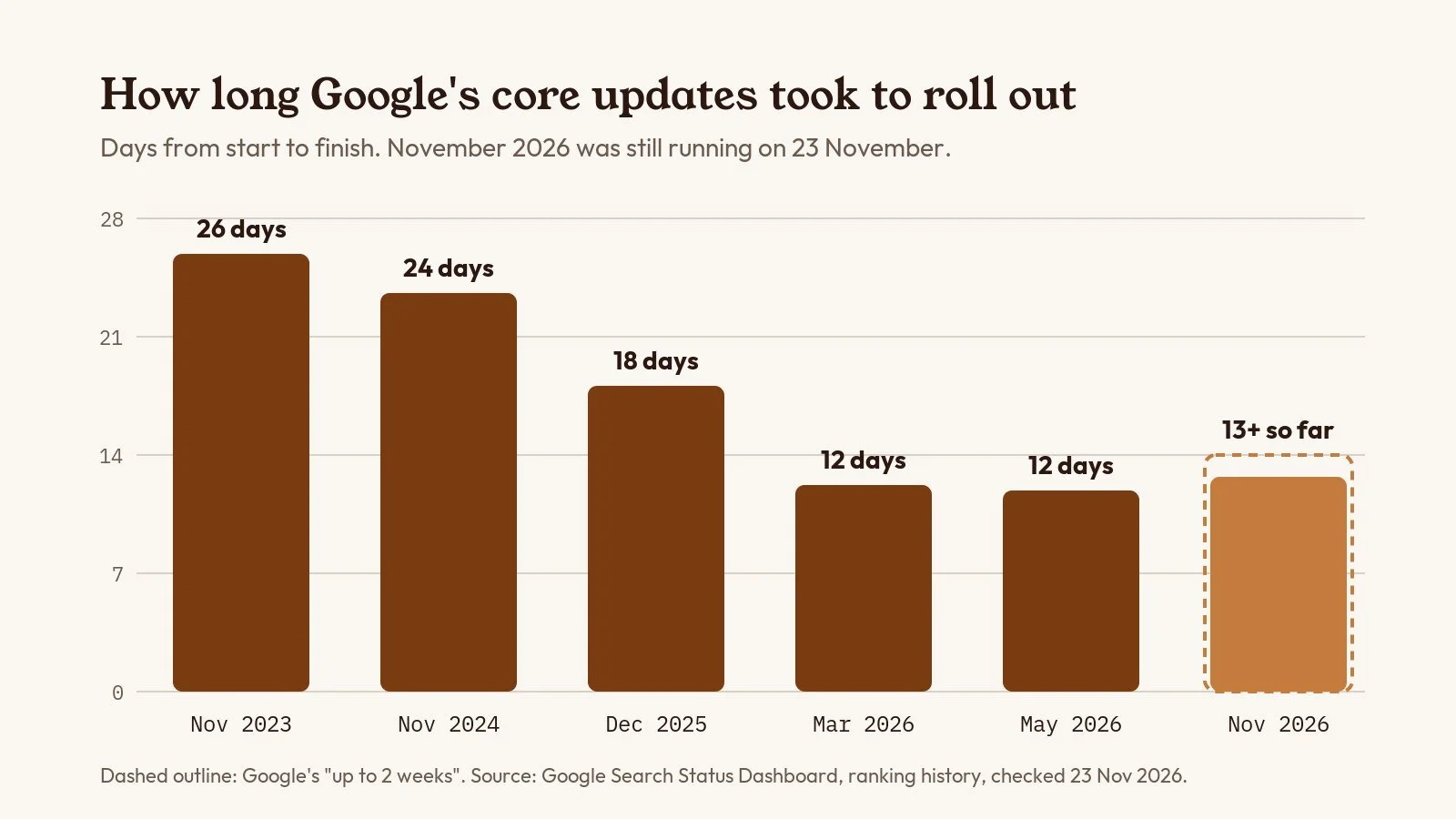
On 10 November 2026, Google posted on its Search Status Dashboard that it had "Released the November 2026 core update, which applies globally and to all languages." It added: "The rollout may take up to 2 weeks to complete."
A core update is a broad change to how Google ranks pages. On the morning of 23 November, the dashboard still showed no finish date.
When will the November 2026 core update finish?
If it takes the full two weeks, it ends on Tuesday 24 November. That is three days before Black Friday on 27 November.
It may run longer. Google's own dashboard shows the November 2024 core update took 23 days and 13 hours, and the November 2023 one took 25 days and 21 hours. This year's March and May updates each took about 12 days.
When should you check your rankings?
Not this week. Google's guidance on core updates is specific: "We recommend waiting at least a full week after a core update completes before analyzing your site in Search Console."
If the update finishes on 24 November, the dates work like this:
Wait until Google marks the update as finished on the Search Status Dashboard.
Wait seven more days. On a 24 November finish, that week runs 25 November to 1 December.
On Wednesday 2 December, open Search Console, then Performance, then Search results. Compare 25 November to 1 December with 3 to 9 November, the week before the rollout began.
Sort your top pages and queries by average position, not clicks. Christmas demand moves clicks. Position tells you whether Google moved you.
If you sell online, Black Friday sits inside that week. Look at 2 to 8 December as well before you decide anything. If the finish date slips, move every date by the same number of days.
What counts as a real drop?
Google gives two examples. A small drop, "dropping from position 2 to 4", needs no drastic action, and Google adds: "we recommend avoiding making changes to content that's already performing well".
A large drop, "dropping from position 4 to 29", calls for a deeper look. For a small business, that means reading each page that fell and asking whether a stranger would find it more useful than the page that now ranks above it. Google calls deleting content "a last resort".
Is there a Search Console trap to avoid?
Google's data anomalies page lists a logging error that cut impressions on the Generative AI performance report for 9 to 11 November 2026. Google says "This issue affects data logging only."
9 November is inside your comparison week. If you use that report, compare against 2 to 8 November instead, or you'll see a rise that isn't real. Our guide to Search Console's AI search data explains where that report sits.
Our take: leave your website alone until December
The worst move this month is a panicked rewrite in Black Friday week. You can't yet tell what the update did, and changing pages mid-rollout muddies the only data you'll have to judge it.
Google says most sites "don't need to worry about core updates and may not even realize one has happened." We're applying that to our own site. New posts keep going out, and the older ones stay untouched until the December check.
What to do this week
Write 10 November in your analytics notes, so next year's November dip has an explanation.
Bookmark the Search Status Dashboard and check it for the finish date.
Keep publishing new pages. Hold back on rewriting pages that already rank.
If December sales lean on Google, line up a fallback: an email to your list and fresh Google Business Profile posts.
If your traffic still looks wrong on 2 December, we'll go through Search Console with you. Want to know how your business shows up in Google and ChatGPT? Book a free 30-minute check, or read how we think about SEO and AI search together.
Frequently asked questions
When did the Google November 2026 core update start?
Google released it on 10 November 2026 at 10:07 Pacific time, which was 18:07 in the UK. Google said it applies globally and to all languages, and that the rollout may take up to two weeks. On 23 November, Google's Search Status Dashboard still showed no finish date.
How long should I wait before checking the core update's effect?
Google recommends waiting at least a full week after a core update completes before you analyse your site in Search Console. Then compare that week with the week before the rollout began. For the November 2026 core update, the earlier week is 3 to 9 November.
Should I change my website during a core update?
Not the pages that already perform well. Google recommends avoiding changes to content that is performing well, and says a small drop, such as position 2 to 4, needs no drastic action. A large drop, such as position 4 to 29, deserves a deeper look once the core update ends.
Is a Google core update a penalty?
No, Google says core updates are broad and "don't target specific sites or individual web pages". A page that drops isn't necessarily bad, because other pages may now be judged more helpful. If you improve a page, Google says it could take several months to show.